
Railway Street
For a small, residential street in Dublin 1, Railway Street has had more names than most streets in the city.
Mecklenburgh Street
Originally know as Martin’s Lane or Great Martin’s Lane,1 the street originally consisted of two stretches, the ‘upper’ part from Marlborough Street to Gardiner Street, and the ‘lower’ part from from there to Buckingham Street.
In 1761/2 the street was named ‘Mecklenburgh Street, in honour, as M’Cready says, of Princess Sophia Charlotte of Mecklenburg-Strelitz,2 who in 1761 married King George III. She went on to become the United Kingdom’s longest serving Queen Consort, and to be played by Helen Mirren. (The gone-but-not-forgotten Charlotte Street, at the top of Camden Street, was also named for the Queen.)

Wilson’s Directory for 1762 gives the name of the upper portion as ‘Mecklenburgh Street’,3 and by 1769 both sections bore that name.4
Tyrone Street
By 1886 the ‘lower’ part of the street, from Gardiner Street to Buckingham Street, had gained an ‘evil reputation’, the ‘respectable working class’ owners of property and residents in Upper Mecklenburgh Street alleging that ‘many of the houses in Lower Mecklenburgh Street are used for improper purposes and inhabited by persons of the worst character’.
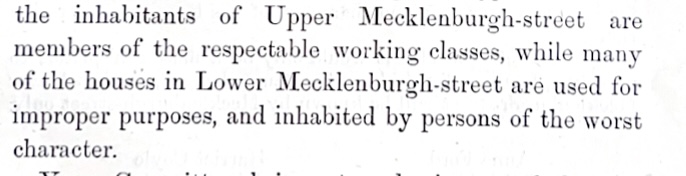
In a memorial to the Paving Committee,5 signed by both the curate of St Thomas’s and the priests of the Pro-Cathedral – truly an ecumenical matter – they suggested Tyrone Street as the new name, that deriving from Tyrone House, on Marlborough Street, former home of the Earl of Tyrone.
The owners’ request that the name of the street be changed was approved by the Corporation’s Paving Committee, who noted that ‘by this arrangement Lower Mecklenburgh Street will the only street bearing that name, which for a long time past has been notorious’.
However, the residents of Lower Mecklenburgh Street were not happy with this new arrangement, and in 1888 asked that the name of that street be also changed, to ‘Drogheda Street’.
In a memorial to the Paving Committee,6 it was reported that
A number of humble residents with grown families find it impossible to gain employment for the female portion as domestic servants, &c., owing to the bad character bourne by Mecklenburgh Street,
At the meeting of the Corporation on 18 December 1888, ‘Tyrone Street’ was instead proposed. Two councillors objected on the grounds that to give this name to the street would insult both the people of an Irish county and ‘the memory of a famous Irish chief’.
Councillor Charles Dawson, he who defended the honour of Hugh O’Neill, suggested the practical ’Railway Street’, but the council voted 19 to 10 to change it to ‘Tyrone Street, Lower’.7

Waterford Street and Railway Street
The Tyrone Street name lasted until 1911, when the ‘evil reputation’ which the street had once-again gained, led to another change in name.
The memorial from the residents of Upper Tyrone Street, supported by the clergy of both denominations, claimed that ‘the lower part of the street in question is inhabited by persons of the undesirable class‘, and that ‘decent workmen residing in Upper Tyrone Street were refused employment on account of the unsavoury nature of the address’. They suggested ‘Waterford Street’ and this was approved by the Corporation.8
I can find no reason for the name, but perhaps it comes from the Marquessate of Waterford, to which the 2nd Earl of Tyrone was elevated in 1789.
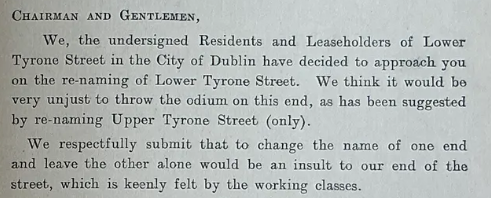
The people of Upper Tyrone Street obviously had little regard for Lower Tyrone Street, but the residents there were also unhappy with the Tyrone Street name, and the same year they asked that the name of their portion be changed. In their request, they claimed that ‘several houses of ill repute have been closed and de-tenanted, and only a respectable class of occupiers are now resident in the locality‘.
Referring to the changing of the name of Upper Tyrone Street, they said ‘it would be very unjust to throw the odium on this end, as has been suggested by renaming Upper Tyrone Street only.9
At its meeting of 13 November 1911, the Corporation changed the name of Lower Tyrone Street to ‘Railway Street’.10 The ‘Railway’ presumably from the nearby Amiens Street Railway Station.
Railway Street remains, and, somewhat ironically, it was Waterford Street which fell into ruin; it was last listed in Thom’s in 1986,11 and was built over sometime after that.
- Rocque, 1756.
- M’Cready, p. 64.
- Wilson’s Dublin Directory, for the year 1762: containing an alphabetical list of the names, occupations and places of abode of the merchants and traders in the city of Dublin (Dublin, 1762).
- Ibid., 1769.
- Reports 1886/75.
- Reports 1888/110.
- ‘The Dublin Corporation’, Irish Times, 18 December 1888, p. 6.
- Minutes 1911/744.
- Reports 1911/174.
- Minutes 1911/760.
- Thom’s 1986.
6 Comments